
Apps to Download Before You Go to China (2026)
WeChat, Alipay, Amap, DiDi, Railway 12306 and NIA 12367: what each does for a visitor, what to set up at home, and which to install first.

Six apps cover most of what a first trip to China asks of your phone: WeChat and Alipay to pay and to book, Amap for maps, DiDi for rides, Railway 12306 for trains and NIA 12367 for the arrival card. All six work in English, and below is what each does for a visitor, what to set up at home and which to install first. Do the sign-ups before you leave, on your home network, where the SMS codes reach your phone without any roaming settings.
Google Maps, Gmail and most of the apps you’d normally lean on run into China’s network filter on hotel Wi-Fi and Chinese SIMs; a travel eSIM that routes your data abroad gets them through, as roaming on your home SIM does. That’s why this list looks so different from a packing list for Europe.
WeChat and Alipay: the two that run everything else
WeChat is a messaging app first, but in China it’s also a wallet, a booking platform and the place where many museums and temples sell tickets, through “mini programmes” that run inside the app. It’s available in English and 25 other languages. You register with your phone number, and a new account may then be asked for “assistance verification”: WeChat’s help centre says that means a QR scan from an existing WeChat user, or verifying with a payment card instead.
Alipay works the same way for payments and carries a lot of practical services inside it: metro QR codes, ride-hailing and ticket mini programmes. Its built-in translation covers 16 languages and works across in-app services such as taxi hailing, hotel booking and ticket purchases, which matters when a mini programme opens in Chinese.
You want both, because a shop or ticket desk may show only one code. Who can sign up, adding your card, the fee rules and the limits are covered in paying with WeChat and Alipay, so we won’t repeat them here.
Amap instead of Google Maps
To find your way on foot, by bus or by taxi, the app to have is Amap, from AutoNavi. It’s the same app Chinese users know as Gaode; outside China its store listing is called AMap Global. It comes in English as well as Simplified and Traditional Chinese, handles walking, bus, cycling and driving directions, has a taxi service built in and supports offline navigation. Since an update at the end of June 2026 (version 16.19.2), it has a set of visitor features it calls HiChina: arrival guidance, internet access tips and bilingual help cards you can show to someone who doesn’t speak English.
Practise with it at home. Search for your first hotel, save it, and download the offline map for the cities you’re visiting. If your eSIM drops out underground, a saved route still works.
On an iPhone, Apple Maps is a second option: Apple lists mainland China among the places where it offers turn-by-turn navigation and public transport directions. Google Maps is the one that won’t load on hotel Wi-Fi or a Chinese SIM; a travel eSIM that routes your data abroad gets it through, as the eSIM page explains.

DiDi for rides, in English
To hail a car in English, use DiDi, China’s big ride-hailing app. Its listing is clear about visitors: there’s an English version for inbound users, you register with your mobile number, and you can pay with an international bank card. It also has in-app messaging that translates between English and Chinese, and English customer service around the clock. The app’s tagline covers rides in Hong Kong as well as the mainland, so one account does both.
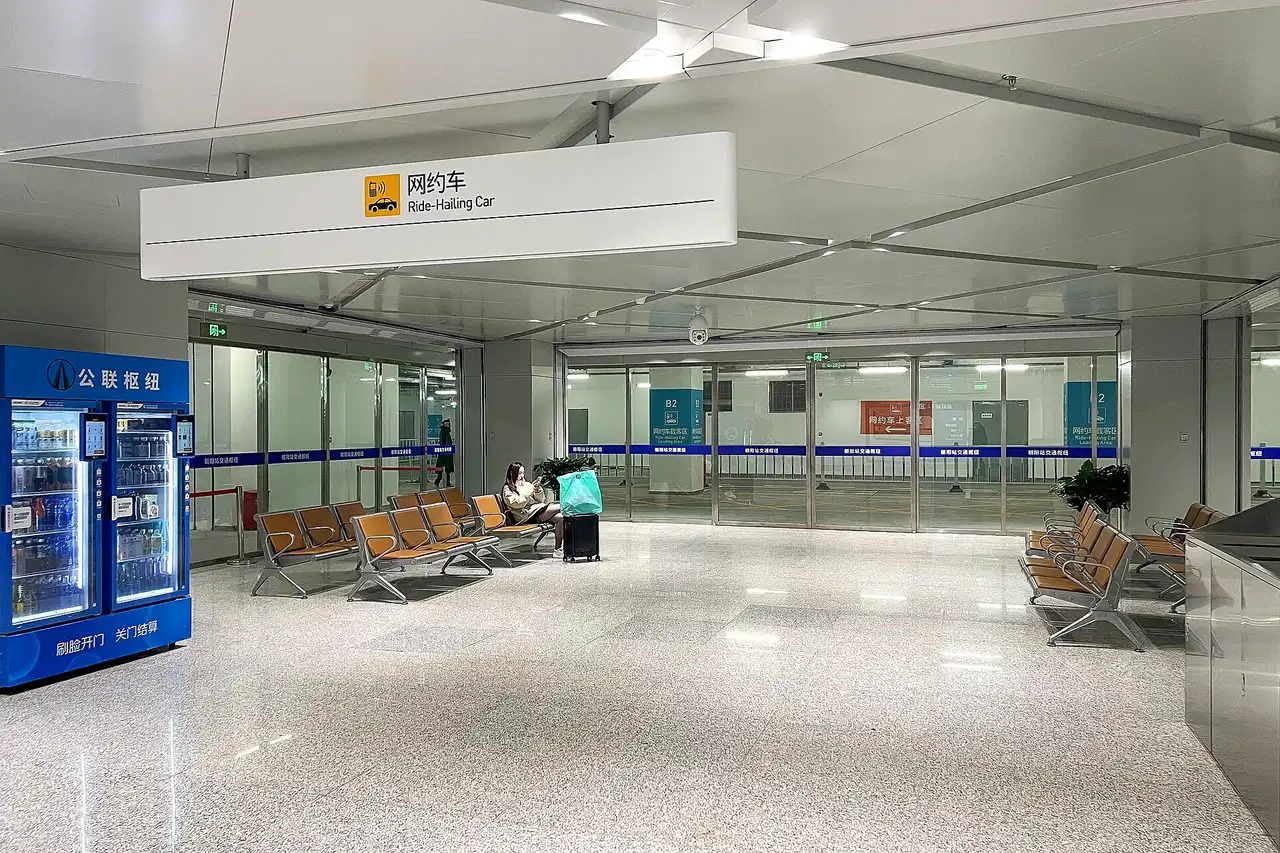
The translated chat is the feature that matters most at pick-up. If a driver messages you about where to meet, you can type in English while they read Chinese, which beats pointing at maps through a car window. Beijing Chaoyang station, for one, has a signed ride-hailing pick-up area, so follow the signs to it rather than waiting at the kerb. In Xi’an, a DiDi is also the simple way out to the Terracotta Warriors in Lintong district if you’d rather skip three metro lines and a bus.
Railway 12306 for trains
Railway 12306 is China Railway’s official ticketing app, made by the Academy of Railway Sciences, and it comes in English as well as Chinese. It sells tickets on a foreign passport, but the passport has to be verified before you can buy, so set up the account a few days before you need your first ticket. Whether to book there or through an agent such as Trip.com, and how the sales window works, is covered in 12306 vs Trip.com.

NIA 12367 for the arrival card
For the arrival card, the app is NIA 12367, from the National Immigration Administration. It’s one of the official ways to fill in China’s arrival card online, along with the NIA website and the WeChat and Alipay mini programmes.
Android users should know one thing first: on 3 October 2026 we found no NIA 12367 listing on Google Play with the store set to the UK, the US, Canada or Australia. On an Android phone, fill in the card on the NIA’s web page or in the WeChat or Alipay mini programme instead; on an iPhone, the app is in the App Store.
You can still do the card at the border, but it’s quicker to fill it in the night before than in the immigration hall. The official web address, and the warning about paid look-alike sites, sit with the entry rules passport by passport.
Metro codes: Alipay or the city’s own app
Many metro systems in China let you ride with a QR code on your phone. In Alipay you’ll find it under Travel: choose the city, confirm your identity and the code appears. Beijing’s metro works this way, and its gates also take contactless foreign cards.
Shanghai has an app of its own, Metro Daduhui, run by the Shanghai Shentong Metro Group, which issues a ride code through Alipay or WeChat; Mastercard and Diners Club holders can link a card through an “International Cards” option in its WeChat Pay channel. You may not need any app there, though. Shanghai’s Tap to Ride lets you touch a contactless UnionPay, Visa, Mastercard, American Express or JCB card on the gates, as long as the card allows small payments without a PIN. Fares and lines are in the Shanghai city guide. For the metro in Chongqing, see the Chongqing city guide.
Tickets that live inside WeChat
A lot of museums, temples and attractions sell tickets through WeChat mini programmes, often in Chinese only. The Shanghai Museum is a good example: individual visitors book on its official WeChat mini programme, overseas visitors are pointed to Trip.com, and the museum’s app and applet only have a Chinese version. Badaling, the Great Wall section with its own high-speed station, opened its WeChat ticket platform to passport holders in 2024; our Mutianyu vs Badaling comparison has the details.
Others have English booking sites. The Palace Museum in Beijing, the Forbidden City, sells tickets on its booking site and takes international bank cards. Check each place’s official site before you go, and when it points to WeChat, open the mini programme from a link or QR code on that official site rather than from a search result.

Help lines worth saving
Apps fail at awkward moments, so save the human numbers too, offline, in your contacts:
- Immigration: the NIA’s 24-hour line, +86 12367, with English among its languages.
- Trains: China Railway’s customer service, +86 12306.
- Rides: DiDi’s English customer service runs around the clock inside the app, so it’s reachable from the trip screen.
Calling a +86 number from your home SIM costs whatever your carrier charges for international roaming calls, so check that rate before a long call on hold.
If you install only three
Make them WeChat, Alipay and Amap. The two wallets cover paying, most bookings and the metro, and Amap fills the gap Google Maps leaves on hotel Wi-Fi and Chinese SIMs. Add DiDi if you’ll take cars at night or with luggage, Railway 12306 if you’re booking trains yourself, and NIA 12367 on an iPhone to have the arrival card done before you land.
Read also

Before you go · 9 min read
China in Winter: Weather, Crowds and What Stays Open
Verified · 13 October 2026January lows run from -22.9°C in Harbin to 19.5°C in Sanya. Which cities have heating, when winter hours start, and which week is crowded.

Before you go · 8 min read
Chinese New Year 2027 in China: What Closes and When
Verified · 10 October 2026New Year's Day is 6 February 2027; the State Council hadn't set the break by mid-October 2026. What closed in 2026, the rail window, dates to watch.

Before you go · 13 min read
China Itinerary: 10 Days or 2 Weeks by Train (2026)
Verified · 3 October 2026Beijing, Xi'an and Shanghai in 10 days with one night train, or 2 weeks with Pingyao and Hangzhou: real 12306 trains, fares and what to book when.

Before you go · 13 min read
Mutianyu vs Badaling: Great Wall Day Trip from Beijing
Verified · 6 October 2026Badaling is 19-23 minutes by train from Qinghe; Mutianyu is quieter, with a ¥140 return cable car. Tickets, buses and passports, section by section.